I had a simple goal: start a blog to share my technical adventures and misadventures involving Linux, free software and related subjects. I came up with a solid structure, an honest layout, did some research on platforms and that was it — I decided to host everything on GitHub. It seemed like a logical and natural path, since a blog about Open Source has to live on GitHub, right?
Seemed right.
They say setting up a static blog with Hugo is “quick and easy”. That’s what the YouTube tutorials, recorded by people who probably don’t own an FX-6300 and a genetic inclination toward stubbornness, try to sell you. The reality? It’s trench warfare against .toml files and folder hierarchies that look like they were designed by a sadistic architect.
The Original Plan
The idea was simple: get Teimoso do Linux online.
- Engine: Hugo
- Theme: PaperMod
- Goal: have a place to document my technical shenanigans without the distractions of social media
Everything was going reasonably well, until I thought:
“But it would be nice to have a comment section at the bottom. After all, every blog has one.”
Little did I know that this “final act” — configuring a simple comment box — would become my final boss.
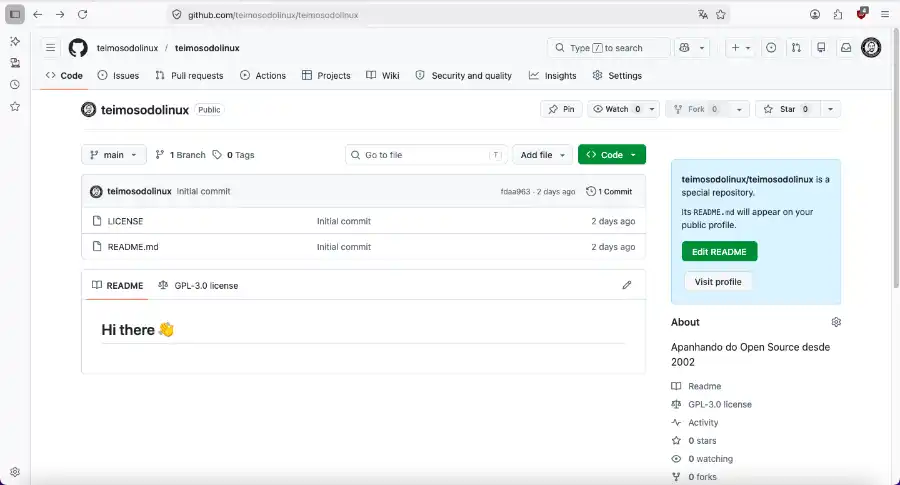
Creating a GitHub account was the easy part.
The Tools Odyssey
1. Disqus — The Traditional Route
“If master Fabio Akita uses it, I’ll use it too”, I thought. Let’s go with Disqus. I configured the shortname, adjusted the configuration file and… nothing. The footer remained a desert of grey pixels.
Disqus is like that proprietary driver you know should work, but decides to go on strike without emitting a single error log.
2. Giscus — The Nerd Route
I turned to Giscus. “Let’s use GitHub Discussions!”, I shouted at the walls. The result? The blog, in an act of pure rebellion, decided to render the script source code on screen instead of executing the tool.
Seeing your own HTML code printed as if it were a concrete poem is a transcendental experience, but not particularly functional.
3. Cactus.chat — The Privacy Route
I tried to be ethical. I tried to be minimalist. Cactus.chat promised Matrix-based comments, no tracking and a clean interface.
Hugo responded by displaying only the title “Comments”, followed by an existential void.
The Goldmark “Scream”
Along the way, I discovered that Hugo has a security system called Goldmark that, by default, treats any “strange” HTML as a biological hazard.
I tried to disable the lock with the famous:
unsafe = true
Hugo not only ignored the command, but screamed syntax errors that made me question whether I still knew how to read a configuration file.

Nothing like an exasperating day of combat against the terminal.
Lessons From a Day of Combat
After hours editing partials, creating layout overrides and restarting the server (hugo server -D) more times than I rebooted my first Slackware, I reached an important conclusion:
“Done” is better than “perfect”, but “posted” is better than “exhausted”.
The blog is live. The tags are there. The search (which also put up a fight!) is operational. The design is clean.
The absence of comments right now might be the universe sending a warning: before listening to other people’s opinions, I first needed to finish setting up my own space.
Next Steps
If you’re reading this and want to comment — sorry: you can’t. At least not today. The comment box is still an urban myth on this domain. I certainly forgot a misplaced comma in some hidden configuration file, or deleted something I shouldn’t have.
But rest assured: the stubbornness is not dead. It just went to sleep to avoid throwing the laptop out the window.
Verdict: Hugo 1 × 0 Sanity. (But there will be a rematch.)